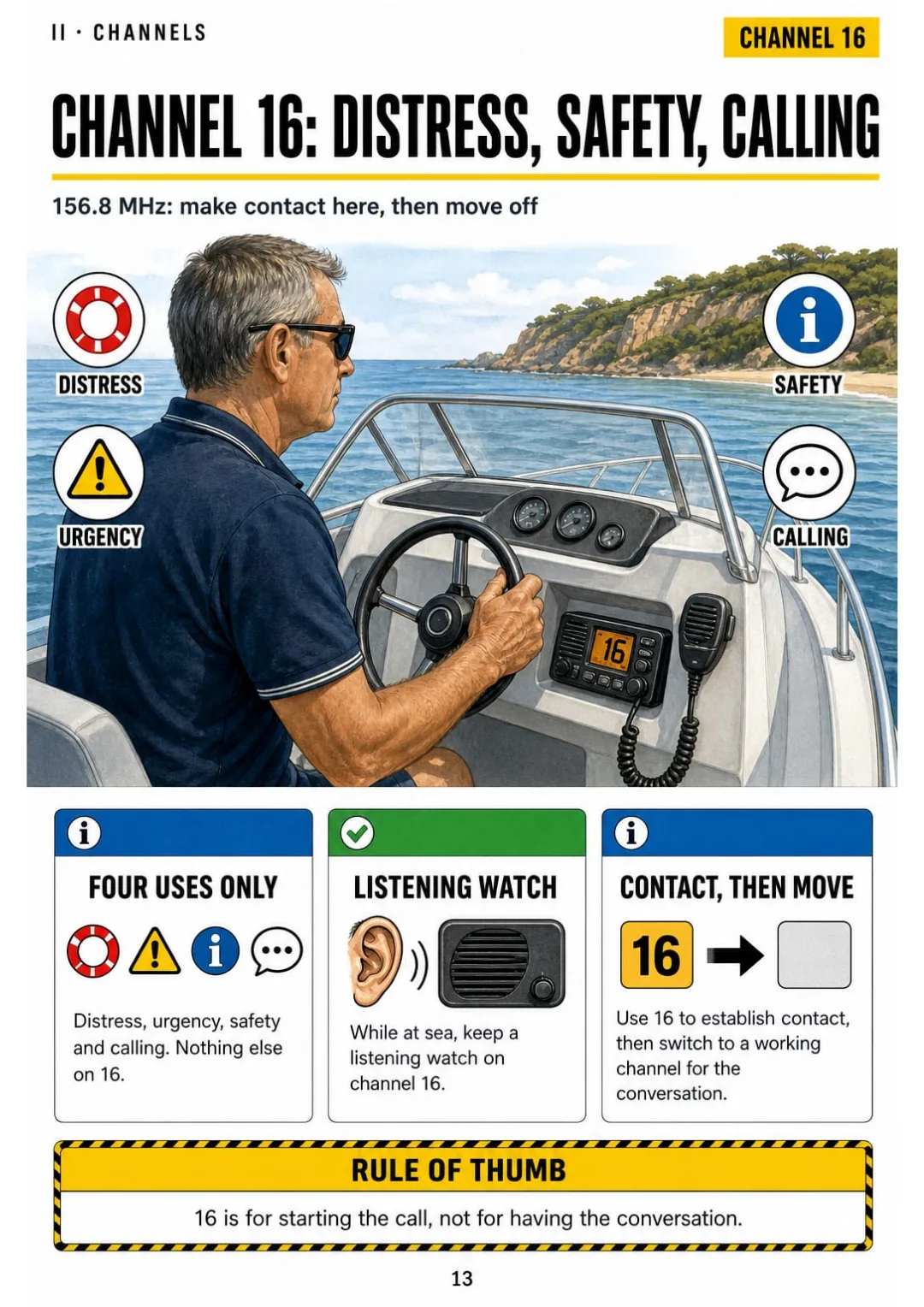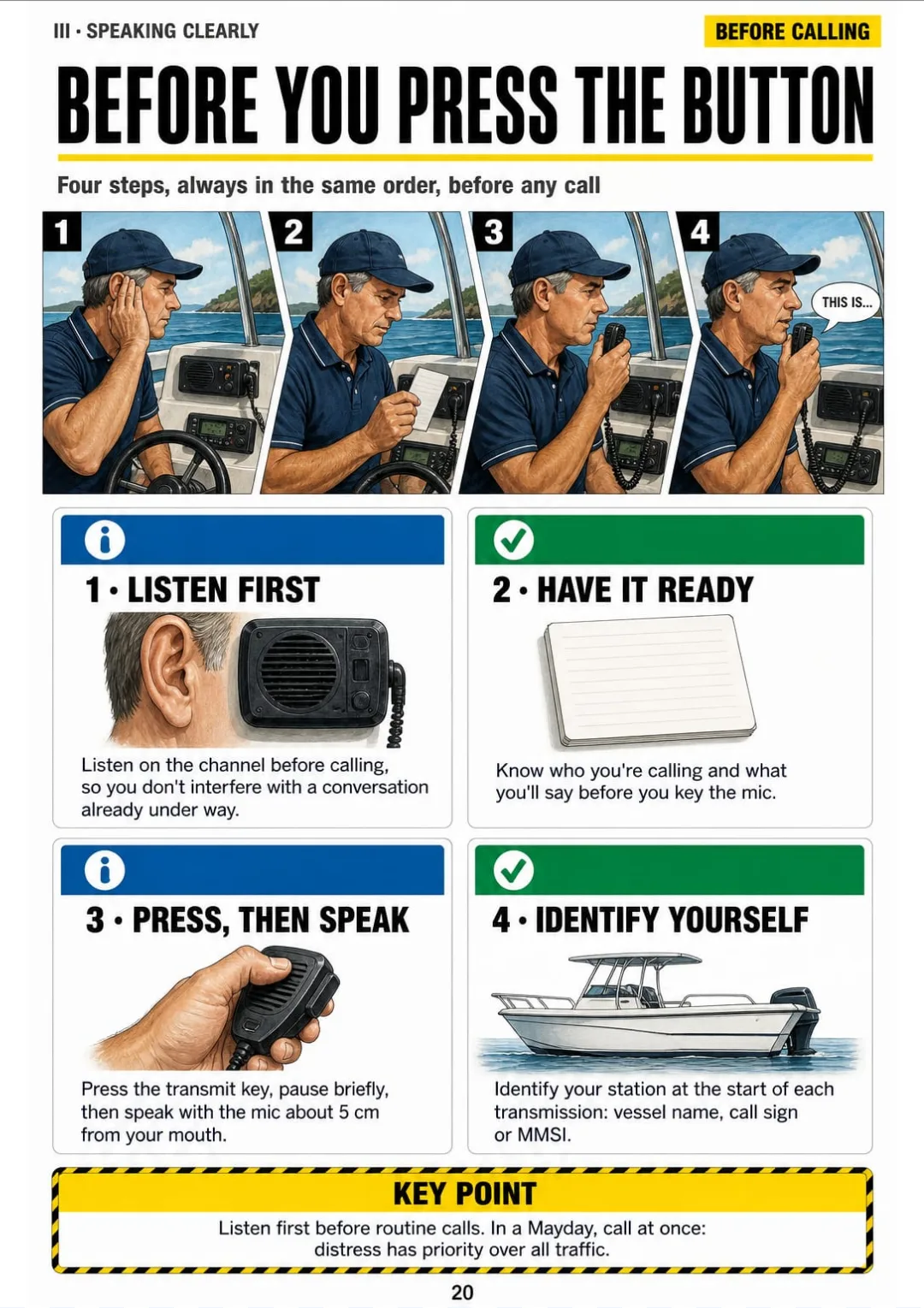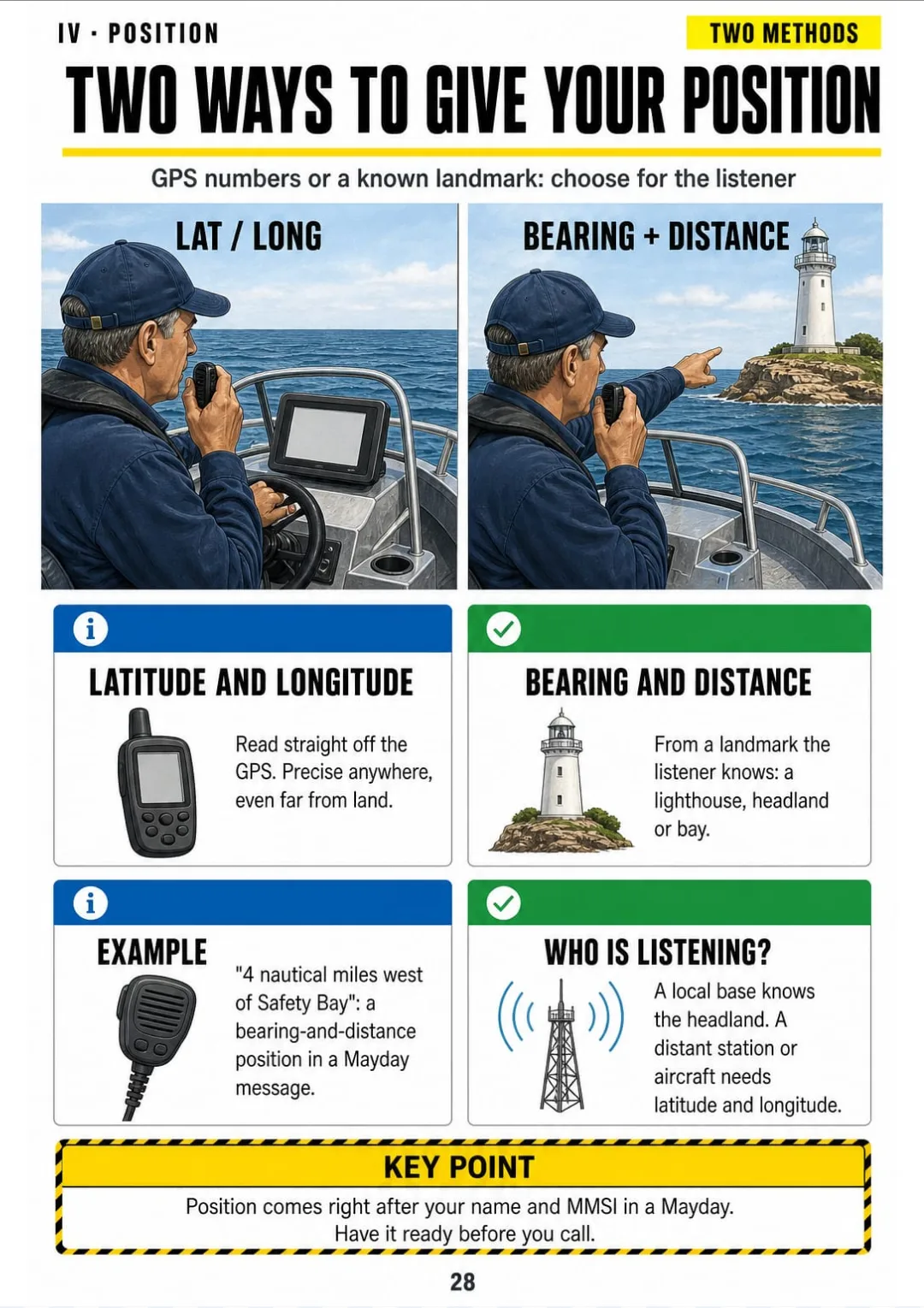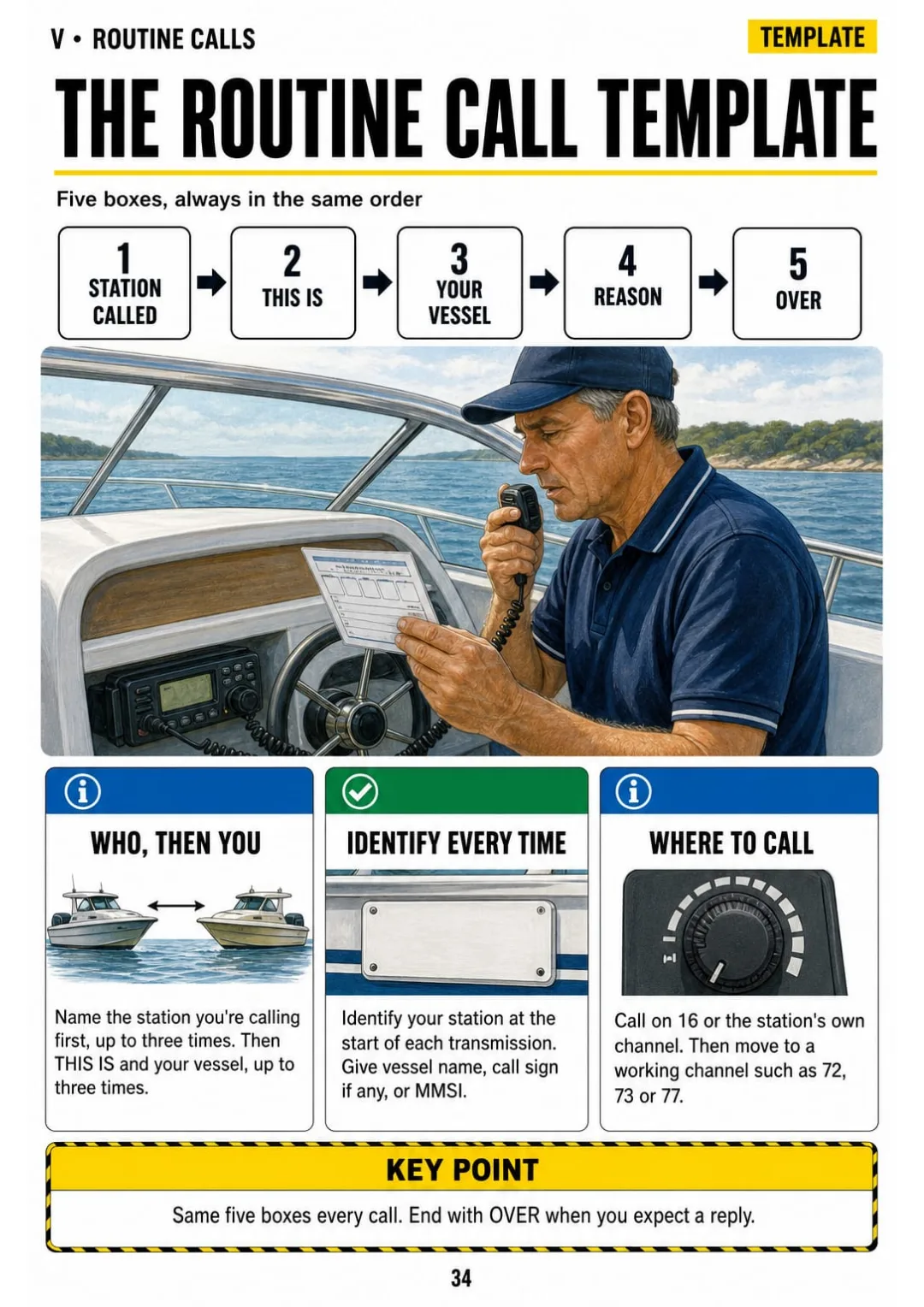
📄 Digital book in PDF · read it on your phone or print it
Built on the Australian VHF channel plan: channels, prowords, the phonetic alphabet, giving your position, routine calls, Mayday, Pan-Pan and Sécurité, DSC and EPIRB. Each topic has its own page: the drawing first, then what you need to remember. 66 illustrated pages.
🔒 Secure checkout · PDF by email · 30-day guarantee
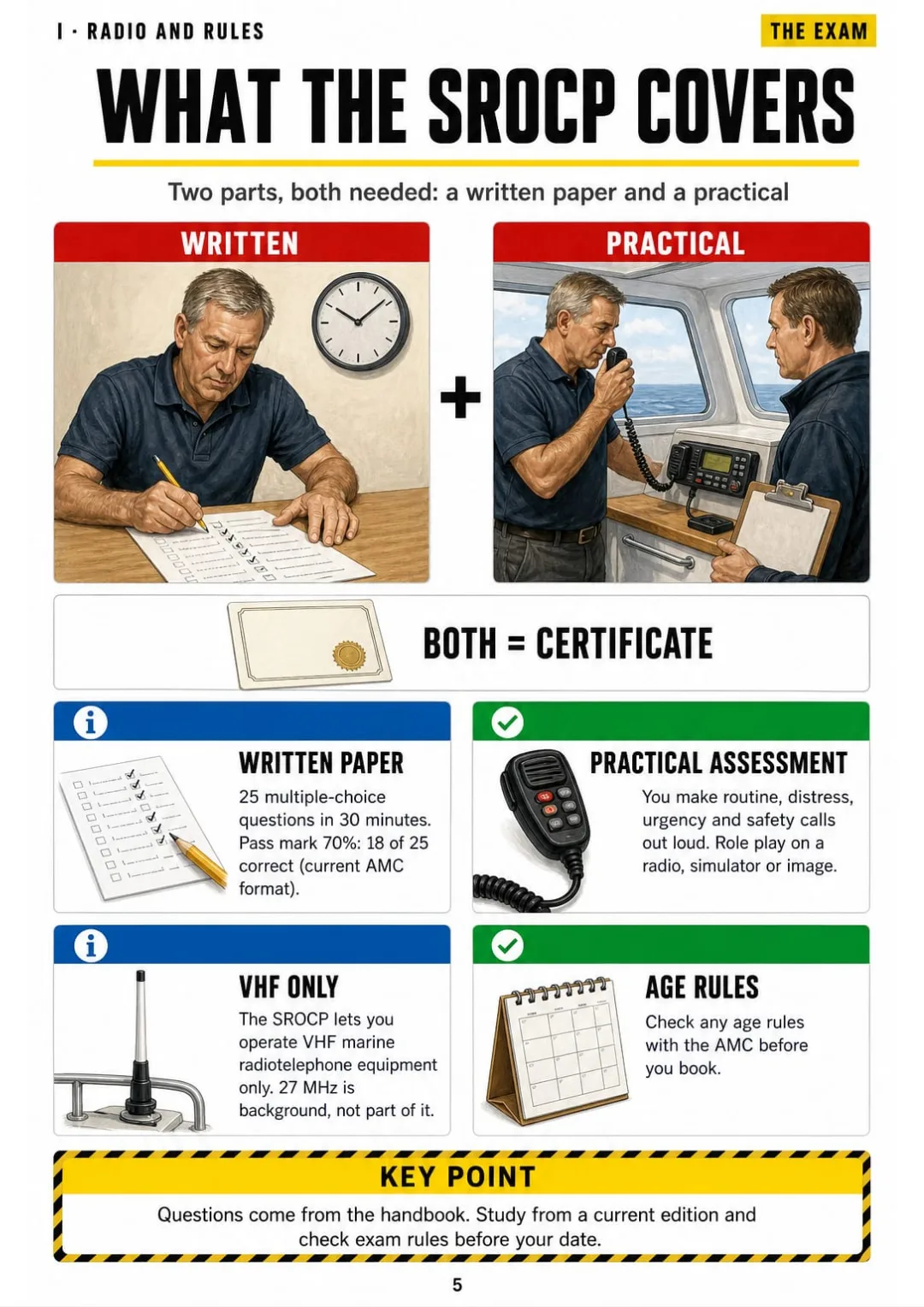
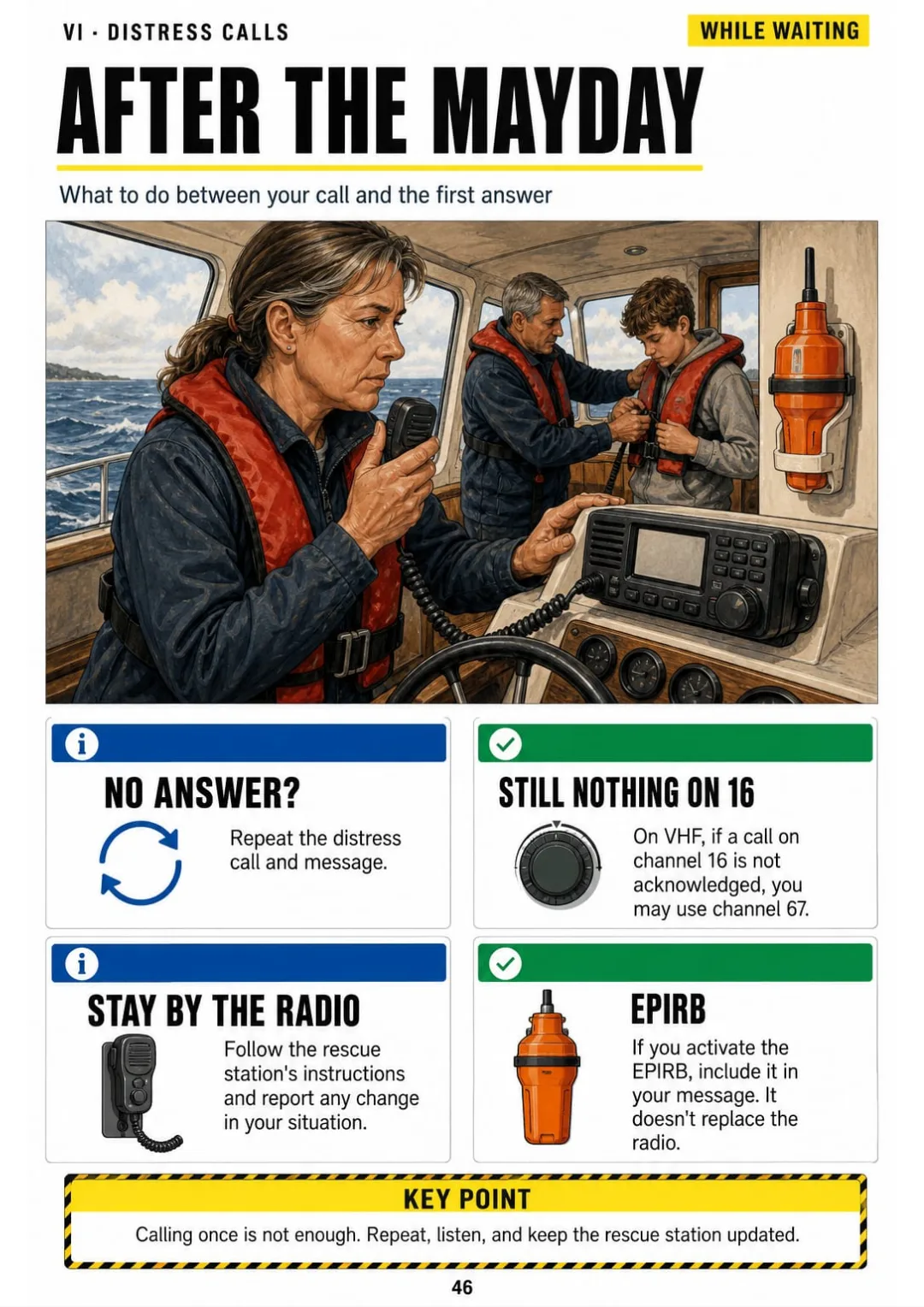
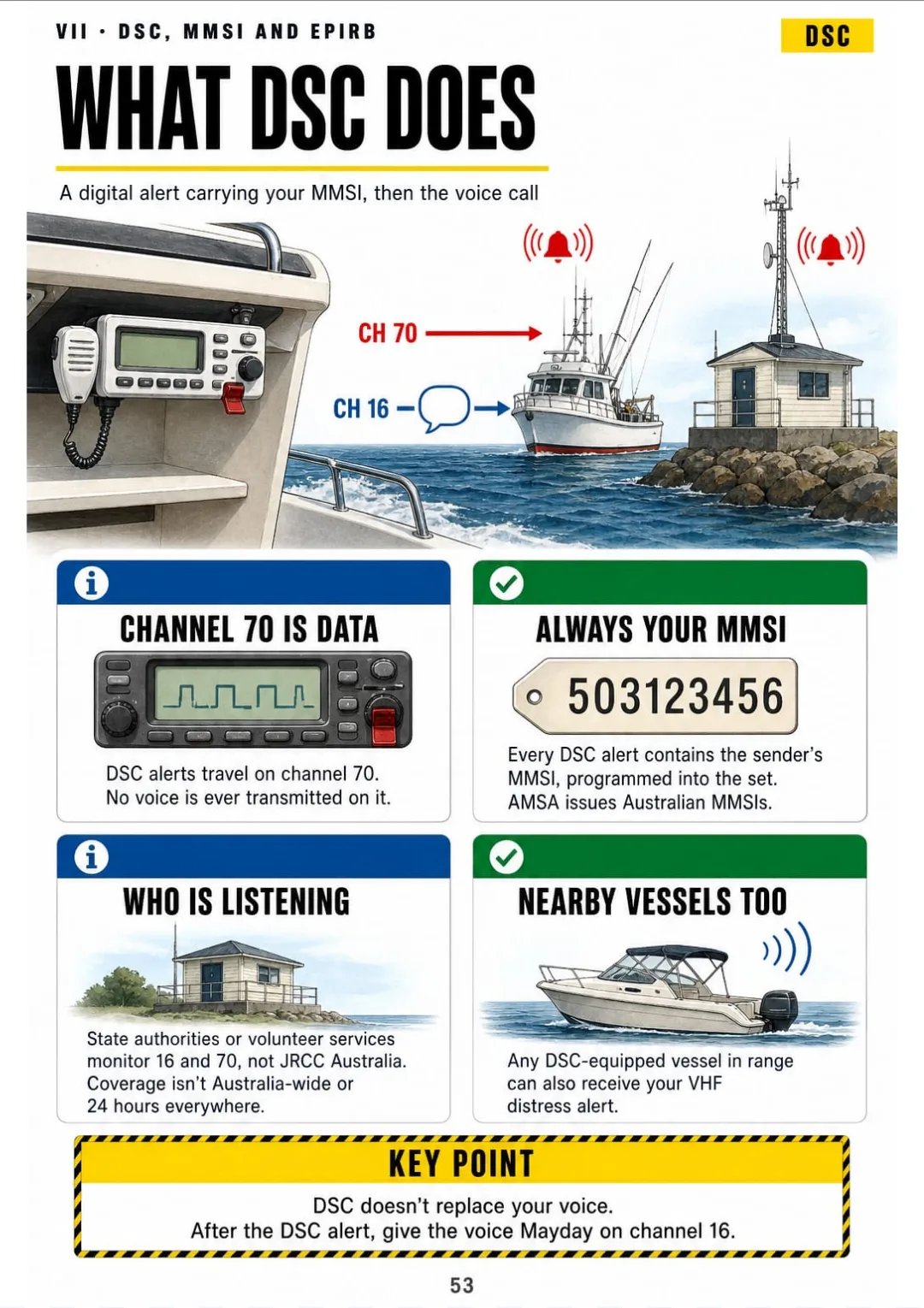
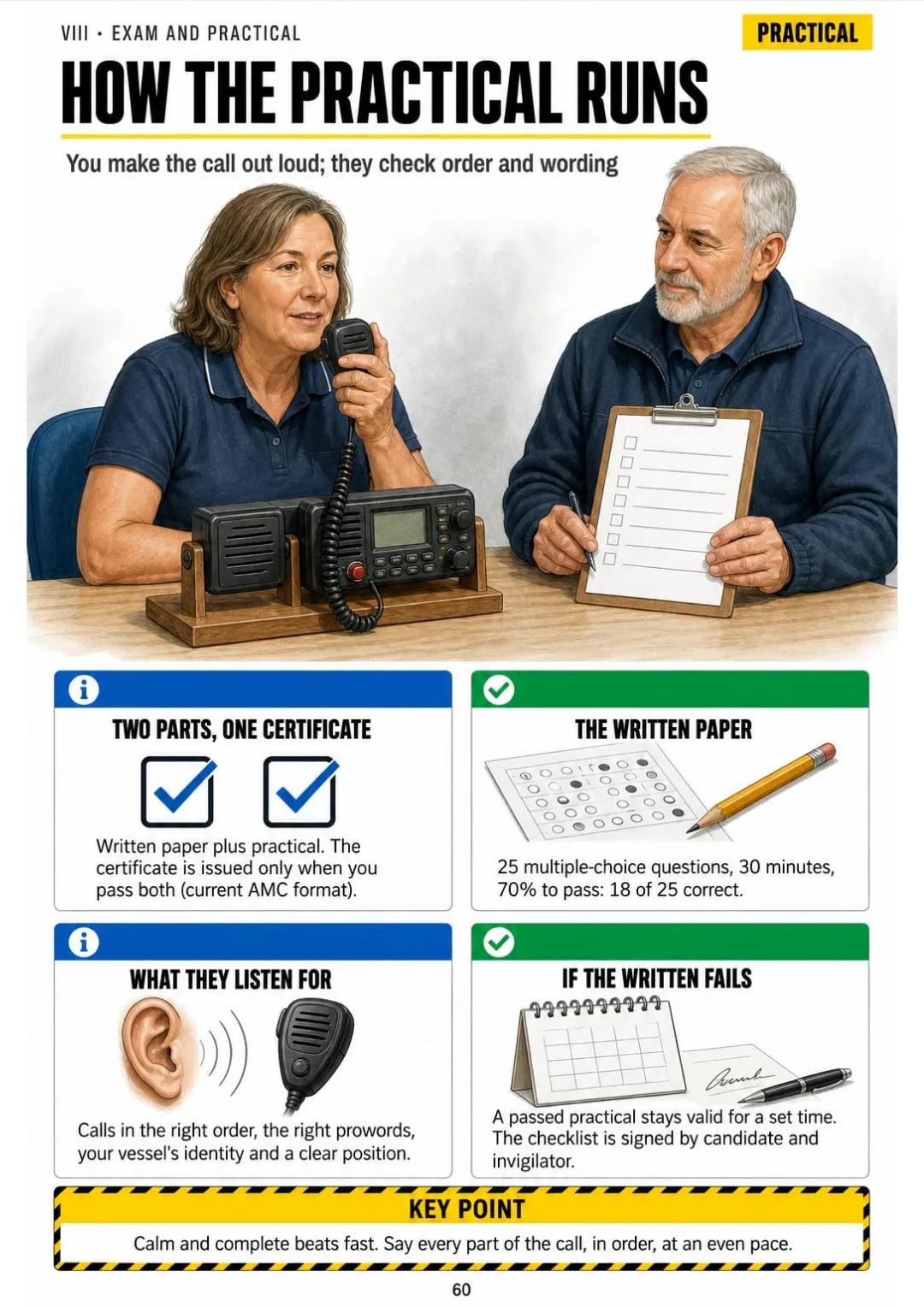
Every page has one big drawing and a box with the channels, prowords and steps you need to know:


Swipe to see more →
These are real pages from the book. The table of contents is the full one: 8 parts and 62 topics.
You're at the helm with the handset in your hand, about to make a call, and your thumb is already on the button.
Then the doubt kicks in: do you listen first? Do you say your vessel's name or the station you're calling? The handbook covers it in two dense paragraphs, and words alone don't come back when someone's waiting to hear you.

In this book, that moment is one page: an ear first to check the channel is clear, then the station you're calling, "this is" and your vessel's name, drawn as a sequence you can follow with your finger.
The same goes for channel 16, the phonetic alphabet, giving your position, the routine call template and the Mayday: each one has its own page.
You see the order, you understand it, and you make the call without reaching for the handbook.

Your radio and the rules, channels as a colour map, speaking clearly on air, giving your position, routine calls, Mayday, Pan-Pan and Sécurité, DSC and EPIRB, and the exam and practical: 66 pages, all illustrated.
Think of it this way:
It's your practical. The assessor hands you the handset and says: fire on board, make the call. You've got a few seconds to start, and it has to come out in the right order.
In the book you open the Mayday page and see it drawn as a script: Mayday three times, "this is" and your vessel's name three times, then Mayday and your name again, where you are, what's wrong, the help you need, how many on board, and over.

The same with channels 16 and 67, the phonetic alphabet, bearing and distance from a landmark, the radio check and the DSC button: each one on its own page.
Marine VHF Radio Illustrated is 8 parts and 62 topics, all drawn, with three practical scenarios, the most common radio mistakes and a card for the helm at the end.
What you see drawn, you don't have to memorize.
What the SROCP covers, who needs a certificate, the parts of a fixed and a handheld set, squelch, line of sight and the rules on air.
Simplex and duplex, channels 16, 67 and 70, working channels, port operations, repeater channels and the 27 MHz band.
What to do before you press the button, over and out, the core prowords, the phonetic alphabet, numbers, your vessel's identity and time on air.
Latitude and longitude read aloud, bearing and distance from a landmark, nautical miles and kilometres, and what to say when you're not sure where you are.
The routine call template, calling another vessel, the radio check, logging on with a coast station, when nobody answers, low power and broadcasts.
You'll know which of the three calls fits the situation and say it in order: three priorities as three signs, Mayday or Pan-Pan, the Mayday call and message, your own Mayday card, acknowledging, relaying, radio silence, Pan-Pan, Sécurité and cancelling a false alarm.
What DSC does, your MMSI, connecting the GPS, the distress button, receiving an alert, EPIRB and PLB, and which to use first.
How the practical runs, three practical scenarios, the most common radio mistakes, channels and prowords on one page and your card for the helm.
At the end of the book: Three practical scenarios, the most common radio mistakes and a card for the helm.

Exam-style questions with every answer explained, so you find the gaps before the written test, not during it.

The Mayday, Pan-Pan, Sécurité and routine calls on printable cards, plus the most common radio mistakes, to keep next to the set and run through before the practical.
📄 This is a digital PDF book sent to your email: nothing is printed or shipped.
PDF by email: We email you Marine VHF Radio Illustrated as a PDF, together with the two free books. It's a single payment: no installments, no extra charges.
You haven't sat an exam in years. Every topic on its own page, drawn first, in plain language: from the radio itself to the Mayday, always in the same order.
The routine, Mayday, Pan-Pan and Sécurité calls as scripts to say out loud, three practical scenarios and practice questions to find the gaps before the day.
Charter, fishing or tour crew: channels, prowords and the distress calls on pages you can print and keep next to the set.
📄 This is a digital PDF book sent to your email: nothing is printed or shipped.
Try Marine VHF Radio Illustrated for 30 days, bonus books included.
We refund everything if the file won't open, if the book isn't what you see here, if you were charged twice or if the email doesn't arrive. Just email us.
You pay once. No subscriptions.
Yes. It starts with the radio itself and goes one topic per page, in plain language, with every call drawn in the same order. Australian channels and metric units.
From current ACMA guidance on marine radio and the Marine Radio Operators Handbook used for the SROCP, with the Australian VHF channel plan. Cited for reference only.
No. It's an independent illustrated study book. It isn't issued, approved or endorsed by ACMA, AMSA or any examining body.
No. You still sit the SROCP exam and practical with an approved provider, and you keep using the course handbook. This book doesn't replace it: it takes the same calls and puts each one on its own page, drawn in one fixed order, so you can rehearse them out loud and keep the cards by the radio.
No. They're written for this book, in the style of the exam, with every answer explained.
The book and the 2 bonus books arrive as PDFs by email, to the address you enter at checkout.
No. It's a one-off payment.
Yes. The PDFs are made to print, so you can keep the pages and the call cards on board, next to the radio.
You have 30 days. We refund everything if the file won't open, if the book isn't what you see on this page, if you were charged twice or if the email doesn't arrive: just email us.
No more rereading the handbook with nothing sticking.
The Mayday call: you see it drawn and that's it.
You walk into the practical knowing where every call starts.
Drawings make studying faster.
The book is right below.
One-time payment: US$ 27 · Guarantee: 30 days · PDF by email
YES, I WANT MARINE VHF RADIO ILLUSTRATED FOR US$ 27📄 This is a digital PDF book sent to your email: nothing is printed or shipped.